Tim Jackson joined BBC One’s Sunday Morning Live for a live debate on whether economic growth harms the planet, following renewed international discussion about moving beyond GDP as the main measure of progress.
In this interview with Olivier Berruyer for Élucid, Tim Jackson explores how capitalism has made growth and consumption central to our idea of happiness—while relying on permanent dissatisfaction to keep going. Leaving consumerism behind, he suggests, is not a step backwards, but an essential step towards a truly prosperous and sustainable society.
Climate breakdown should be understood as a profound abdication of care, argues Tim Jackson in an opinion piece commissioned for the British Medical Journal's (BMJ’s) new year special issue on climate breakdown.
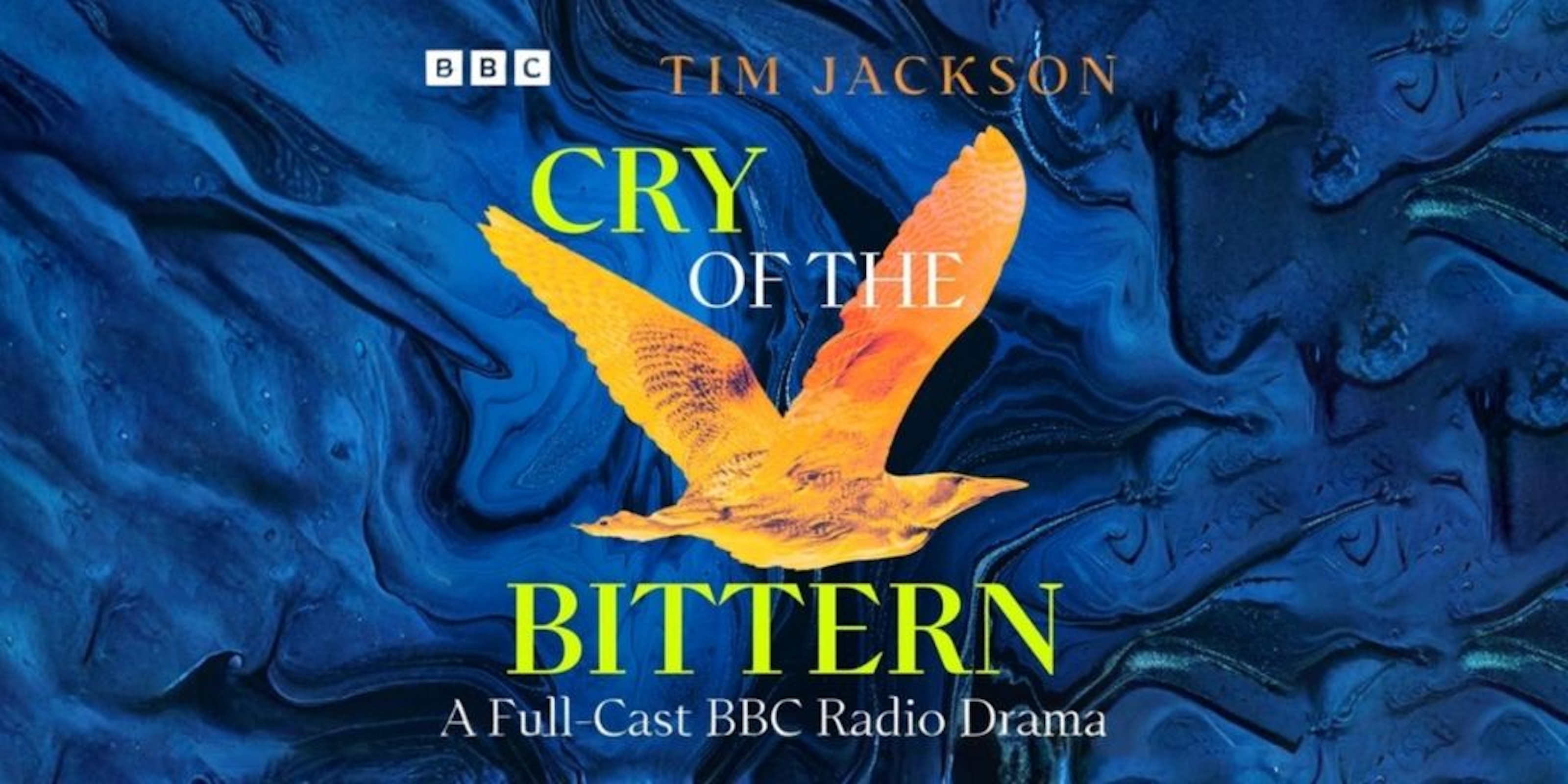
This month sees the audiobook release of Tim Jackson’s environmental drama series Cry of the Bittern. Originally broadcast on BBC Radio 4, the series has been re-released by Penguin and is now available on all major audiobook platforms. Set against the atmospheric backdrop of the Norfolk fens, the full-cast mystery explores the tensions between environmental protection and economic development.
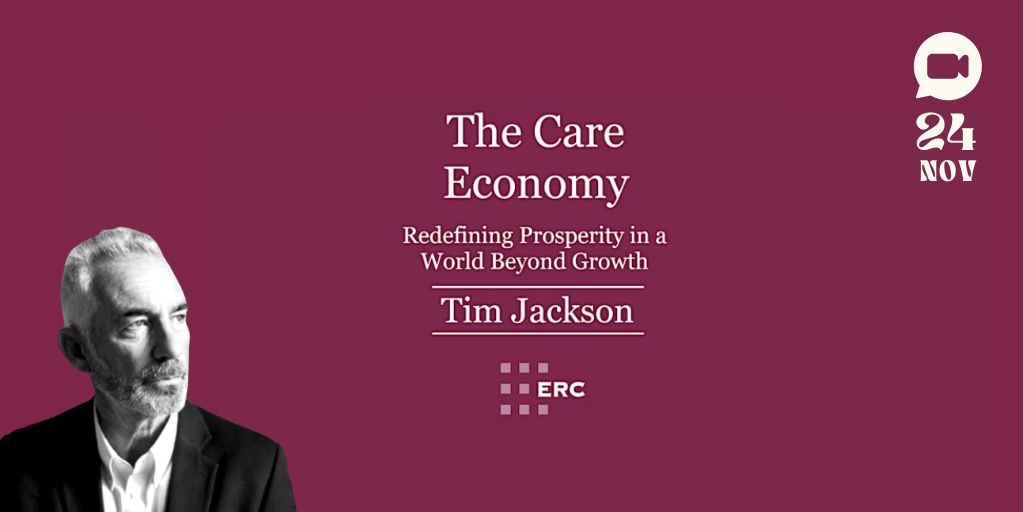
Tim Jackson speaking at the Economic Research Council about The Care Economy, exploring how valuing care as a social and economic foundation can reshape our understanding of prosperity, community, and sustainability in a world beyond growth.
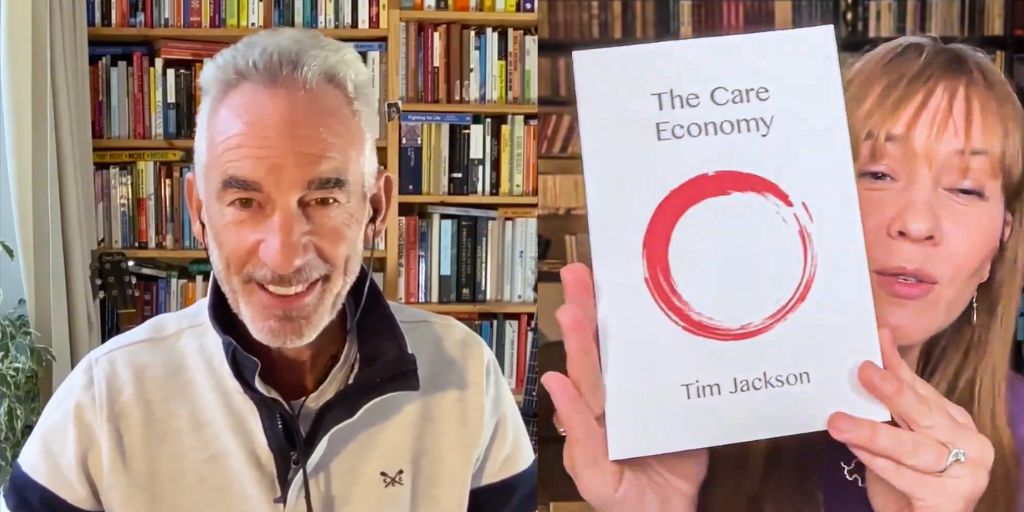
Kristina Mänd-Lakhiani speaks with Tim to explore why modern economics often overlooks care work, how the COVID-19 pandemic exposed the essential foundations of society, and what a truly sustainable, care-centered economy might look like in practice, including the social, economic, and cultural shifts required to achieve it.
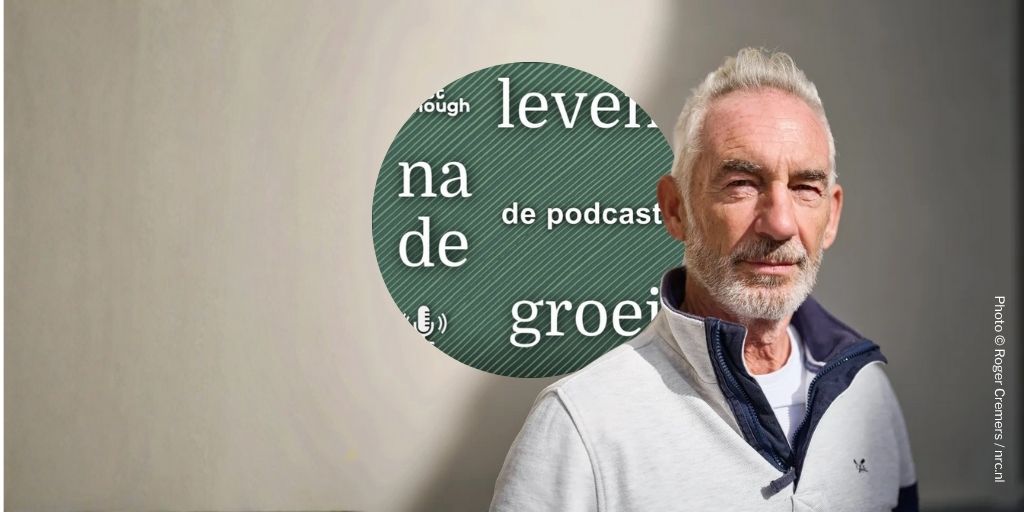
During a recent visit to the Netherlands, Tim Jackson joined Paul Schenderling for a conversation on post-growth economics, ecological limits, and the future of prosperity. The discussion explores ideas from Prosperity without Growth and The Care Economy, and examines how ecological-economic thinking can inform social and policy change.
Under capitalism, we have learned that more is always better: more innovation, more consumption, more wealth. But we can’t keep growing forever, we need to build a postgrowth society, where economic growth is no longer the leading principle.
The pursuit of productivity often sidelines the essential work of care—whether for children, the sick, or the elderly. Catherine Liu, Tim Jackson, and David Goodhart, chaired by Barry C Smith, explore how society might revalue care as central to human and economic life.
Join renowned economists Tim Jackson and Kate Raworth at The Conduit for a thought-provoking event asking: what if prosperity were measured in health, not wealth? Together, they explore how an economy built around care—rather than growth—could transform our societies, markets, and future.
This study investigates where people experience flow today, drawing on UK and international survey data. It examines both the activities and physical environments associated with flow, offering updated insights into how everyday spaces may support psychological wellbeing.
In this episode of The Deep Dive, host Phillip McKenzie speaks with Tim Jackson about his latest book, The Care Economy. The conversation examines how the pandemic and recent global conflicts have underscored care's critical importance, yet revealed its consistent neglect within current economic systems focused primarily on growth and profit.
This paper examines how slower growth in advanced economies may force a choice between fiscal tightening and rising debt. It shows that more flexible approaches to monetary and fiscal policies can better support debt stability and long-term economic, social and environmental goals.
"Ask not what we can do for our health. Ask only what our healthcare can do for growth." In this searing critique, Tim Jackson exposes how the UK Government’s new 10-year-plan for NHS England trades public health for private profit, betraying Bevan’s vision in the name of growth.
In a wide-ranging and deeply reflective conversation with Terrence McNally on Free Forum: A World That Just Might Work, Tim Jackson explores the themes of his latest book, The Care Economy. Against a backdrop of global instability and the rise of authoritarianism, Jackson argues that now, more than ever, is the time to advocate for an economy built on care rather than growth.
In a thoughtful and wide-ranging conversation with Will Brehm, Tim Jackson explores the personal and political dimensions of The Care Economy, his latest book. Sparked by a surprising diabetes diagnosis, Jackson shares how a personal health crisis led him to question not only his own lifestyle but the broader systems that shape our wellbeing. His journey through nutrition, chronic illness, and the failings of modern medicine reveals how society has systematically undermined health by prioritising profit over care.
In this podcast, Tim explains the problems with our need for constant growth—how it is not only incompatible with a sustainable future but is also bad for our wellbeing. He also shares what a post growth society premised on a care economy could look like.
As one of the most illustrious rock stars of the sustainability movement, Tim Jackson suggests that we must “fuck the patriarchy” to get beyond capitalism. In his new book, The Care Economy, Jackson argues that our growth-obsessed capitalist economic system is fundamentally dysfunctional, prioritizing wealth accumulation over health and wellbeing.
In his latest book The Care Economy, Jackson issues the powerful warning: our fixation on growth has come at the cost of the most vital parts of our lives—care, health, and human connection. In a world that undervalues care work and prioritises profit over people, what would it take to build an economy centred on wellbeing instead of wealth?
Capitalism is an illness: it’s killing our planet, and by extension, us. Economic instability and environmental concerns are symptoms that can only be cured by redefining prosperity in terms of health and wellbeing, so that we can create sustainable, equitable societies. Tim Jackson joins Cities 1.5 to discuss his new book The Care Economy, arguing that redefining prosperity around care—not growth—offers a path to heal our economy, our healthcare systems, and the planet itself.
Hosted in partnership by the David Hume Institute and EICC Live, this engaging Edinburgh event featured Tim Jackson in conversation with Dr Sarah Birrell Ivory. Together, they explored the central themes of Tim’s latest book, The Care Economy.
In this episode of the Economics for Rebels podcast, Tim Jackson speaks to Alexandra Köves about care as a philosophical principle and economic imperative—challenging the deep structures of a growth-driven patriarchal economy and its systemic neglect of wellbeing.
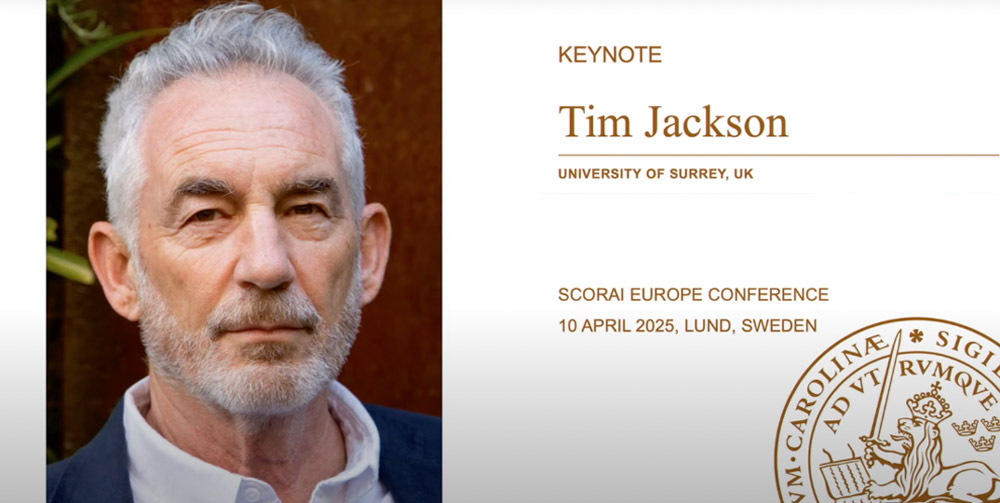
In his keynote for the SCORAI 2025 conference in Lund, Prof Tim Jackson presented insights from his new book The Care Economy, calling for a shift from growth-driven models to economies centred on health, care, and creativity. His keynote exposed the systemic harms of perpetual growth and argued that prioritising care is essential for a just and viable future.
To mark the launch of the German edition of The Care Economy, the Heinrich Böll Foundation hosted a special event in Berlin featuring Professor Tim Jackson in conversation with economist and historian Friederike Habermann. Together, they explored the book’s central themes, delving into its intellectual roots and discussing the urgent need to rethink our economic systems through the lens of care, wellbeing, and sustainability.
On 18 March, CUSP hosted a pre-release launch of The Care Economy at the London Review Bookshop. The evening featured a rich discussion with Professor Tim Jackson, Sir Michael Dixon, and Sir Sam Everington, moderated by Guardian journalist Zoe Williams, offering a thoughtful exploration of the book’s central themes.
In an age of war and permanent crisis, is it all too easy to forget the fundamentals? How do we look after each other, care for one another and create economies that prioritise our human development? In this podcast, Seema Syeda and Zoe Williams welcome back Tim Jackson to talk about his new book, The Care Economy (Polity 2025).
A comprehensive new review by leading experts in the sustainability science field is challenging the long-held assumption that economic growth is necessary for societal progress. Published in The Lancet Planetary Health, this paper explores the rapidly advancing field of postgrowth research and presents a compelling case for prosperity without growth.
This paper develops a stock-flow consistent, input-output model to simulate risks, opportunities, and non-linear dynamics associated with green investment, energy returns, financial risks, and various energy transition pathways to net zero.
New analysis commissioned by the Food, Farming and Countryside Commission (FFCC) has found that the costs of Britain’s unhealthy food system amount to £268 billion every year – almost equivalent to the total annual UK healthcare spend. The report by Professor Tim Jackson provides the first comprehensive estimate of the food-related cost of chronic disease, caused by the current food system.
Climate change is raising questions about a central tenet of economics: growth. Host Carmel Crimmins is joined by economist Tim Jackson to talk about consumerism and the environment and what “post growth” might look like. Plus, we hear from the person who compiles Bhutan’s Gross National Happiness index.
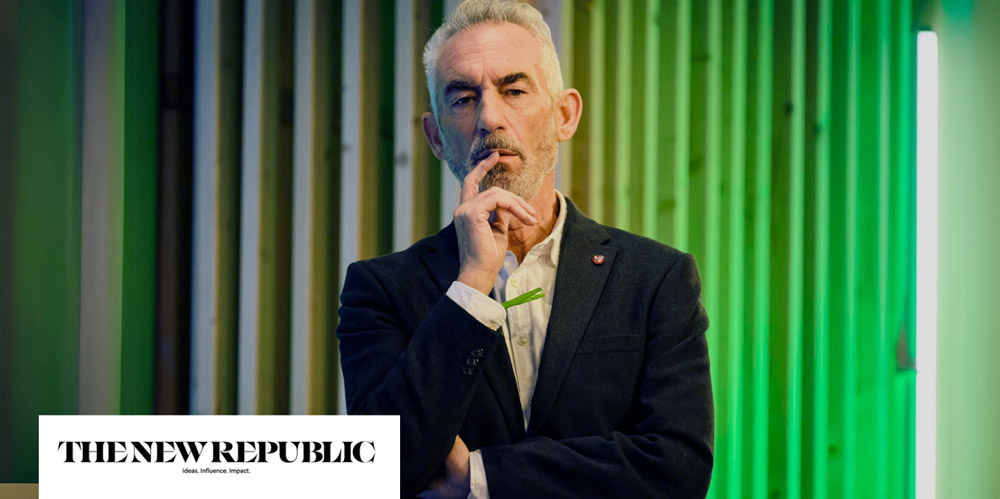
A profile of Tim Jackson, exploring his recent work and the challenges he's tackling in the postgrowth field, written by Nick Romeo for the US magazine The New Republic. The piece is based on in-depth conversations and time Romeo spent accompanying Tim.
This study provides an empirical assessment of how effective the WHO’s Global Monitoring Framework for non-communicable diseases (NCDs) has been in improving COVID-19 resilience in low-income countries. Our findings suggest that future global health policies should focus on the link between NCDs and infectious diseases, especially for vulnerable populations.
This paper shows that countries with robust health-related policy targets aimed at reducing non-communicable diseases (NCDs) experienced significantly lower mortality rates during the first year of the Covid-19 pandemic.
This commentary responds to a recent article purporting to identify ‘limits to degrowth’. This paper clarifies and sets in context the tensions between growth rates and decoupling rates on which the contested argument is based, disputing the claim that growth is the best way to achieve high rates of decoupling.
Modern economies rely on economic growth for stability and prosperity, but this dependence is ecologically unsustainable. Understanding growth dependency is crucial. This paper proposes a sector-led framework to transform these reliances and disrupt their inevitability.
In this working paper, Anastasia Loukianov, Kate Burningham and Tim Jackson explore young people’s use of shared social understandings to describe what is important in their present lives, to envision their futures, and to respond to the challenges they identify to the realisation of their good lives.
The French Ministry of Economy and Finance hosted a conference on 5 December to discuss the trade-offs between emission reduction policies and economic prosperity. Hosted by Minister Bruno Le Maire, speakers of the day included CUSP director Tim Jackson, Sandrine Dixson-Declève, Pierre-Olivier Gourinchas, and Bill Gates.
We are pleased to announce the release of the audiobook edition of Tim Jackson's prize-winning "Post Growth—Life After Capitalism". Through his own narration, Tim brings a personal touch to the profound themes of Post Growth, offering an accessible and engaging experience for audiences to absorb his insights on the go.
Hosted by the former Mayor of Toronto, David Miller, this Cities 1.5 podcast with Tim Jackson is looking to translate the theoretical into the practical, by discussing what cities can do to deliver shared prosperity—not just an unsustainable goal of infinite growth.
#TodayExplained Podcast with Tim Jackson investigating the ailing capitalist model, and ‘why the degrowth movement is having a moment’. Tim recently joined Noel King for her vox.com series on ‘Blame Capitalism’ to discuss the subject, and the emerging relevance of postgrowth economics and policy making.