Rishi Sunak has rolled back the UK's net zero policies and ripped up decades of cross-party consensus on climate change, Tim Jackson writes. "Perhaps consensus is a commodity yet more fragile than consciousness. But its disappearance carries a tragic sense of political and social loss."
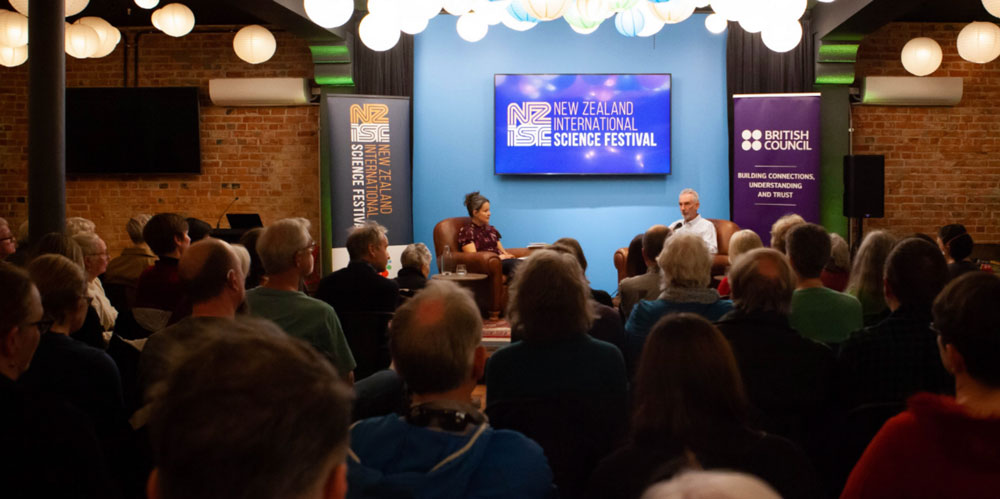
The New Zealand International Science Festival hosted Prof Jackson this year with the support of the British Council New Zealand and the Pacific. He is joined by the Director of the Centre For Sustainability, Caroline Orchinson, for this evening talk.
While we need less growth to put less demand on the planet's resources and slow down climate change, CUSP director Tim Jackson argues that we need more art, more plays and works of fiction to bring both sides of that argument to life.
In June this year, Iceland’s Prime Minister Katrin Jakobsdóttir hosted the first Wellbeing Economy Forum in Reykjavík. Tim Jackson’s keynote there explored the relationship between the ‘wellbeing economy’ and the ‘growth economy’ teasing out where the logic of wellbeing differs from the logic of growth.
To provide prosperity for all while respecting planetary boundaries, it is imperative we transcend both the conventional growth-centred worldview and our growth-dependent economic and social systems. Tim Jackson explores how to get there.
Growth is unsustainable. But the world beyond growth is frightening. We have built an economy that is dependent on growth. We must learn anew how society works, when the economy is not growing. And we need to confront the impossibility theorems presented to us by those who resist change.
Care is an anathema to capitalism. Its virtues are capitalism’s vices. Its employment-rich foundation for wellbeing is capitalism’s ‘productivity crisis’. Yet, without care we are nothing, our progress is nothing. Without care there is no economy.
Sustainability is the art of living well within the ecological limits of a finite planet. Art is more than an instrument in this project. It’s the very nature of it.A talk delivered by Tim Jackson for the Wellbeing Economy Alliance Ireland Hub, March 2023.
This quantitative study of 4000 adults in the UK found that demographic factors only play a minimal role in explaining the likelihood of people being able to experience flow, suggesting that the rewards of flow may be available across society, irrespective of demographics.
This working paper describes a two-region post-Keynesian stock-flow consistent macroeconomic model set out to analyse macroeconomic implications of a postgrowth transition in advanced countries on the economic and environmental conditions in the rest of the world
On 15-17 May 2023, scientists, politicians, policymakers and civil society organisations are gathering in Brussels for the second Post-Growth Conference for Europe. The event is a cross-party initiative of 20 Members of the European Parliament, supported by a wide-range of partner organisations.
This working paper describes an extension of the stock-flow consistent FALSTAFF model to test the existence of a monetary growth imperative. The extension is designed to simulate the phenomenon known as Baumol’s cost disease which arises from the existence of differential labour productivity rates in a mixed economy.
Tim Jackson was invited onto the Radio NZ Saturday Morning programme with Kim Hill to discus post-growth economics, staggering inequalities legitimated by the trickle-down ideology, and the motivation for his most recent book Post Growth-life after capitalism.
Politicians are wrong to believe that we can only afford decent care in good economic times, Tim Jackson writes. Without health there is no wealth. Without care there is no health. Care is investment. It’s not a luxury consumer item.
What may switching to a green economy mean for the way we live and work and is it compatible with economic growth? Together with his invited guests and co-hosts, Amol Rajan is exploring key questions around money, prosperity and the green economy.
Wealthy countries can create prosperity while using less materials and energy if they abandon economic growth as an objective. This Nature comment piece together with Jason Hickel, Giorgos Kallis, Julia Steinberger and more is laying out the key challenges of a just post-growth transition.
Tim Jackson has been awarded the 2022 Eric Zencey Prize in Ecological Economics for his book Post Growth: Life after Capitalism. The prize celebrates outstanding writing on the environmental limits of a finite planet.
The siren call of climate-burning expansion bewitches British politics. More of the same will emerge in the autumn statement, Tim Jackson writes. To all intents and purposes, we’re already living in a post-growth world. And it’s time to take that challenge seriously.
In the Cop27 special, Ian Sample speaks to Tim Jackson about the myth of eternal growth, other ways to think about progress and prosperity, and what an economic system in balance with our planetary system might look like.
As the twin storms of economic turmoil and worsening climate change grip the the world, BBC Radio 4 Analysis examines the future of economic growth. Does it offer a route out of economic malaise, or have its benefits reached a ceiling for developed countries?
In an exciting new partnership with Corner Shop Media Productions, Parents for Future UK and Zero Carbon Guildford, CUSP is co-sponsoring a new weekly podcast series hosted by seasoned journalists Babita Sharma and Katy Glassborow. Mum, Will the Planet Die Before I Do? explores our role as parents and carers in tackling the climate crisis.
Roundtable event with Dennis Meadows, Robert Costanza, Kate Raworth, and Tim Jackson; contributing to the theme of post-growth thinking within the EU institutions and across EU Member States.
Through a series of in-depth interviews with care workers Christine Corlet Walker et al explore the impact of investment firms on working conditions and quality of care in UK care homes. Combined with an analysis of care company accounts generating insights into the impacts of financialisation on the UK care sector, the report shows how investment firms are using extreme strategies to reduce staffing levels and cut costs in the name of profit, with appalling consequences for care.
Whatever the UK government says it’s doing—and not doing—one thing is clear, Tim Jackson writes, the “treasured free-market economy” is never going to compensate for our failure to insulate people’s homes against the cold, and the future against the ravages of climate change.
Strong materialistic values help to maintain consumer capitalism, but they can have negative consequences for individual well-being, for social equity and for environmental sustainability. In this paper, we add to the existing literature on the adverse consequences of materialistic values by highlighting their negative association with engagement in attitudes and actions that support the achievement of sustainable well-being.
Long-term care systems across countries within the OECD have undergone a progressive marketisation and financialisation in recent decades. In this Personal View, we argue that the accomapnying neoliberal market values make poor guiding principles for the care sector, identifying the dysfunctional dynamics that arise as a result, and reflecting on the clinical implications of each, with a focus on facility-based care.
Letter by John Meadley and CUSP director Tim Jackson to the Financial Times, highlighting the urgent need for decent land use policy, to prevent the same predatory financial practices prevalent in the social care sector from taking hold in rural communities too.
On 9 February 2022, CUSP director Tim Jackson gave oral evidence to the Environmental Audit Committee on their beyond GPD inquiry, addressing questions around growth dependency and the limitations of the 'inclusive wealth' concept.
In the years since the financial crisis, a heated debate has broken out amongst macroeconomists about the appropriate roles of fiscal and monetary policy in managing public sector debt. This working paper and accompanying policy briefing introduce the main lines of argument on both sides of the controversy. We find i.a. that a return to fiscal austerity would be both dangerous and unjustified and that moving beyond ideology is key to the levelling-up agenda.
CUSP Director Tim Jackson reflects on the life of and work of the late Thich Nhat Hanh and its relevance for contemporary debates about the meaning of prosperity and power. (This blog first appeared on the CUSP website.)
The Vietnamese Buddhist monk, writer and peace activist Thich Nhat ...
In this article, Amy Isham and Tim Jackson explore the dynamics of a psychological state known as flow. By synthesising the results of a series of experience sampling, survey, and experimental studies, we identify optimal activities that are shown to have low environmental costs and high levels of human wellbeing.
Professor Mihaly ‘Mike’ Csikszentmihalyi was one of the founders of the positive psychology movement and father of the concept of ‘flow’. His death last month at the age of 87 marks the passing of a rare and visionary scientist. In this blog, Amy Isham and Tim Jackson reflect upon his life and legacy.
Press conference on post-growth economics, zero carbon sooner and the climate economics challenge at #COP26. Hosted by Scientists Warning Europe, 5 November 2021.
The economic system to which we are in thrall throws us out of balance, Tim Jackson and Julian Sheather write in this blog. By failing to meet our most essential needs it is doomed to immiserate and, ultimately, sicken us. We urgently need to regain a richer, more satisfying understanding of ourselves, and our place in the world. (This article first appeared on the BMJ website.)
Carbon efficiency is improving, but far too slowly to offset climate change. We need to get beyond our relentless pursuit of growth, writes Tim Jackson for the Economics Obersavatory ahead of COP26. Only a few economists – and even fewer politicians – have challenged the primacy of economic growth. But being frightened to scare the horses is no way to win the race against climate change.
This paper is an update of an earlier briefing note, revised to take account of new findings from the IPCC’s updated 6th Assessment Report (AR6). The broad aim of the paper is to establish how soon the UK should aim for (net) zero carbon emissions.
On 18 October 2021, Tim Jackson talks to Barbara Unmüßig, director of the Heinrich Böll Foundation, about the German edition of his latest book Post Growth—’Wie wollen wir leben?’ (Oekom, 2021). The book is not just a manifesto for system change, but an invitation to rekindle a deeper conversation about the nature of the human condition.
Previous research has shown that the possession of materialistic values can lead individuals to be less likely to experience flow, an important component of well-being. This study tested whether a lack of self-regulatory resources, and a tendency to use self-regulatory resources for avoidance purposes, can mediate this relationship.
Now is not the time to abandon spaceship Earth, Tim Jackson writes in his essay for The Conversation UK Insights Series. Let’s dream of some “final frontier” by all means. But let’s focus our minds too on some quintessentially earthly priorities.