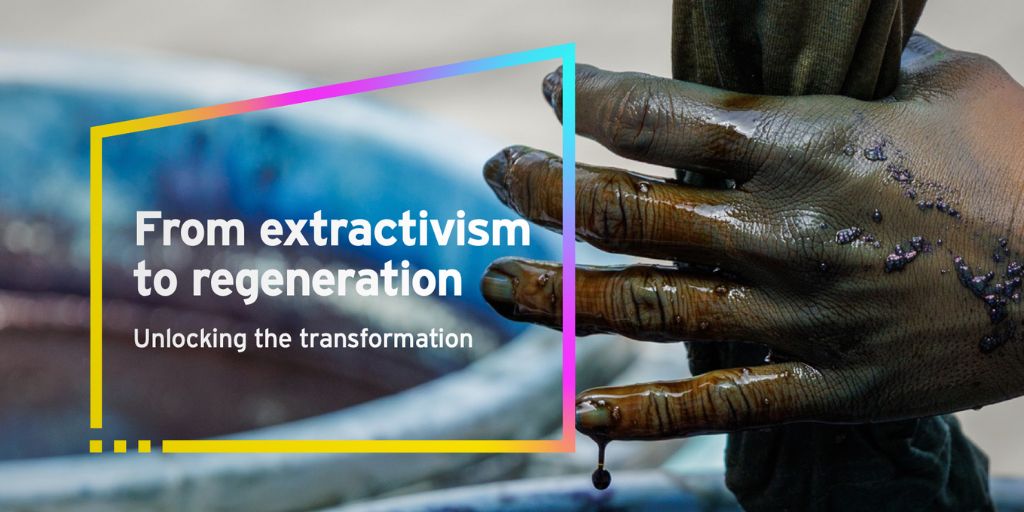
Prof Tim Jackson has contributed to a new report from Ernst & Young’s New Economy Unit (NEU), exploring how businesses can help drive the transition away from extractivism towards a regenerative economy.
A groundbreaking new report from Ernst & Young’s New Economy Unit (NEU) shines a harsh light on the extractivism which characterises modern capitalism and highlights the changes needed for corporate sustainability to move beyond incremental improvements towards a more equitable, resilient and regenerative economic system.
CUSP Co-Director Professor Jackson serves on the NEU’s high-profile advisory committee and played a key role in the writing of the report, co-developing a methodology which, for the first time, tracks the extractivism inherent in modern economies. The report charts a disturbing increase in the privatisation of benefits since the turn of the millennium and an equally worrying rise in socialised losses over the same period. These two trends – the privatisation of benefits and the socialisation of losses – are the core dynamics of extractivism. Both of them have been getting worse over the last quarter of a century, particularly in the G7 economies.
The NEU Advisory Council is a research and insights team established within EY’s Global Climate Change and Sustainability Services (CCaSS) practice. The Unit brings together researchers and practitioners to explore new economic approaches and develop practical strategies for embedding regeneration, equity and long-term resilience into business practice.
Link
The report is available to download from the EY New Economy Unit.
This post also appeared not he CUSP website. Image: © istock.com / Thomas G Weber