In this episode of the Economics for Rebels podcast, Tim Jackson speaks to Alexandra Köves about care as a philosophical principle and economic imperative—challenging the deep structures of a growth-driven patriarchal economy and its systemic neglect of wellbeing.
Capitalism is an illness: it’s killing our planet, and by extension, us. Economic instability and environmental concerns are symptoms that can only be cured by redefining prosperity in terms of health and wellbeing, so that we can create sustainable, equitable societies. Tim Jackson joins Cities 1.5 to discuss his new book The Care Economy, arguing that redefining prosperity around care—not growth—offers a path to heal our economy, our healthcare systems, and the planet itself.
Hosted in partnership by the David Hume Institute and EICC Live, this engaging Edinburgh event featured Tim Jackson in conversation with Dr Sarah Birrell Ivory. Together, they explored the central themes of Tim’s latest book, The Care Economy.
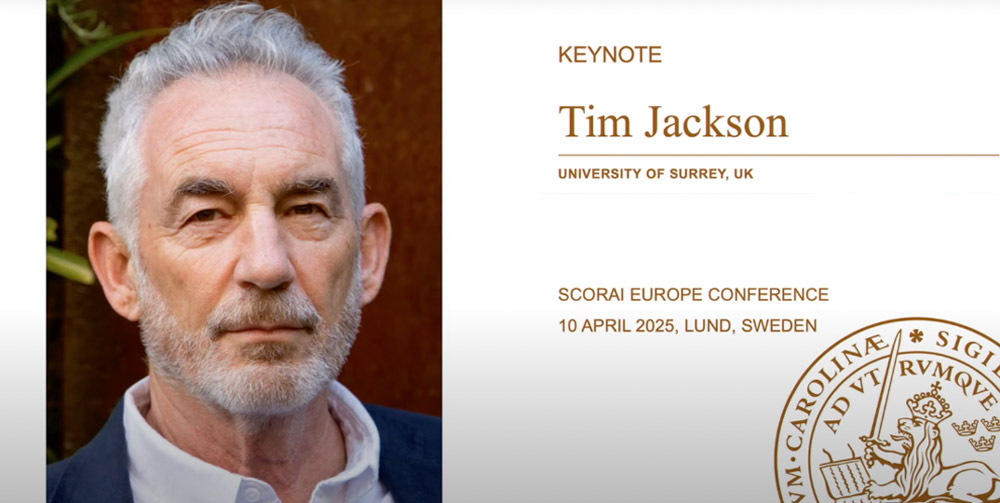
In his keynote for the SCORAI 2025 conference in Lund, Prof Tim Jackson presented insights from his new book The Care Economy, calling for a shift from growth-driven models to economies centred on health, care, and creativity. His keynote exposed the systemic harms of perpetual growth and argued that prioritising care is essential for a just and viable future.
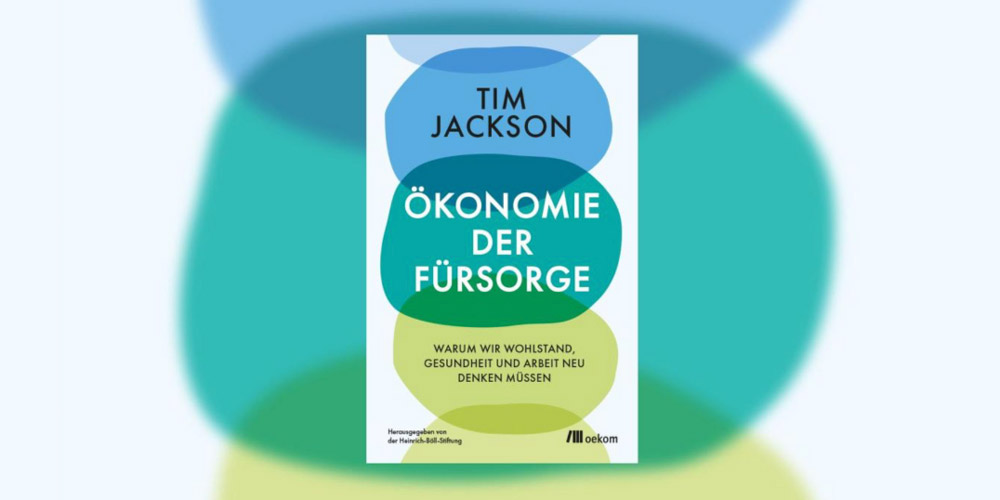
To mark the launch of the German edition of The Care Economy, the Heinrich Böll Foundation hosted a special event in Berlin featuring Professor Tim Jackson in conversation with economist and historian Friederike Habermann. Together, they explored the book’s central themes, delving into its intellectual roots and discussing the urgent need to rethink our economic systems through the lens of care, wellbeing, and sustainability.
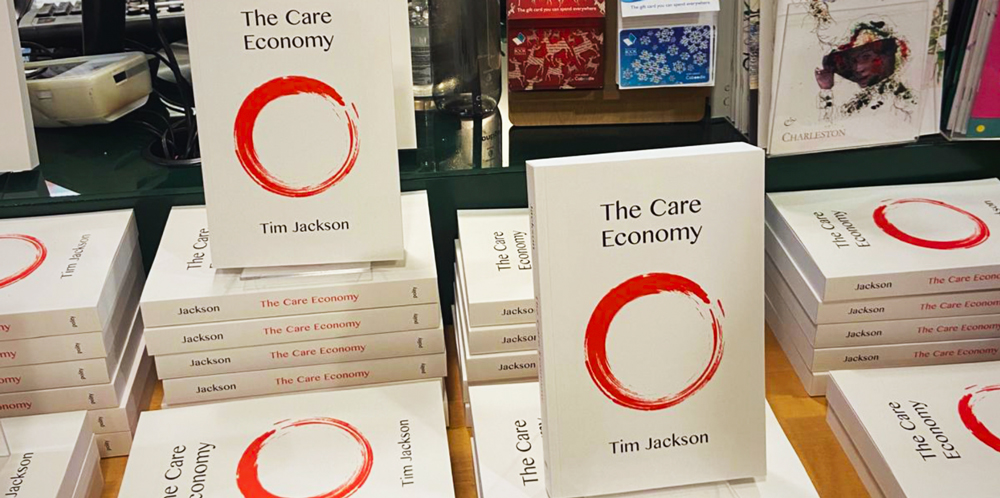
On 18 March, CUSP hosted a pre-release launch of The Care Economy at the London Review Bookshop. The evening featured a rich discussion with Professor Tim Jackson, Sir Michael Dixon, and Sir Sam Everington, moderated by Guardian journalist Zoe Williams, offering a thoughtful exploration of the book’s central themes.
Climate change is raising questions about a central tenet of economics: growth. Host Carmel Crimmins is joined by economist Tim Jackson to talk about consumerism and the environment and what “post growth” might look like. Plus, we hear from the person who compiles Bhutan’s Gross National Happiness index.
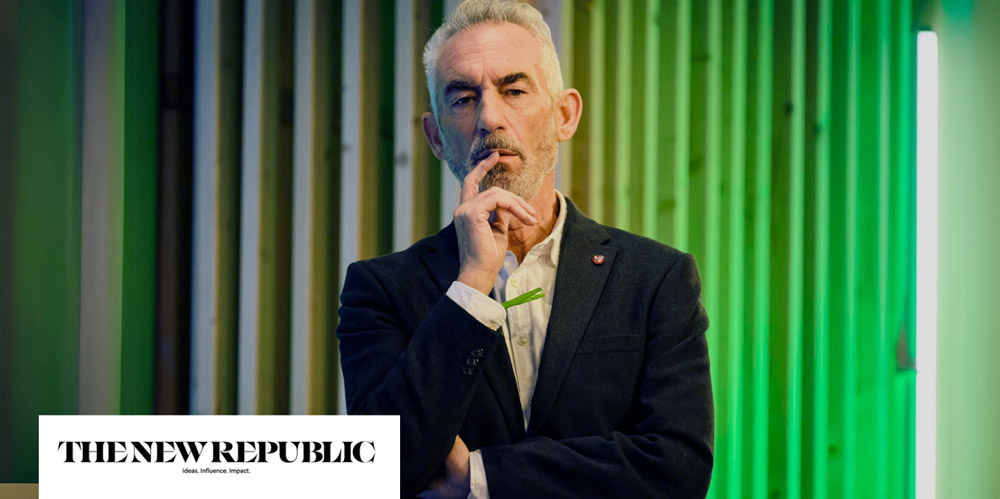
A profile of Tim Jackson, exploring his recent work and the challenges he's tackling in the postgrowth field, written by Nick Romeo for the US magazine The New Republic. The piece is based on in-depth conversations and time Romeo spent accompanying Tim.
The French Ministry of Economy and Finance hosted a conference on 5 December to discuss the trade-offs between emission reduction policies and economic prosperity. Hosted by Minister Bruno Le Maire, speakers of the day included CUSP director Tim Jackson, Sandrine Dixson-Declève, Pierre-Olivier Gourinchas, and Bill Gates.
We are pleased to announce the release of the audiobook edition of Tim Jackson's prize-winning "Post Growth—Life After Capitalism". Through his own narration, Tim brings a personal touch to the profound themes of Post Growth, offering an accessible and engaging experience for audiences to absorb his insights on the go.
Hosted by the former Mayor of Toronto, David Miller, this Cities 1.5 podcast with Tim Jackson is looking to translate the theoretical into the practical, by discussing what cities can do to deliver shared prosperity—not just an unsustainable goal of infinite growth.
#TodayExplained Podcast with Tim Jackson investigating the ailing capitalist model, and ‘why the degrowth movement is having a moment’. Tim recently joined Noel King for her vox.com series on ‘Blame Capitalism’ to discuss the subject, and the emerging relevance of postgrowth economics and policy making.
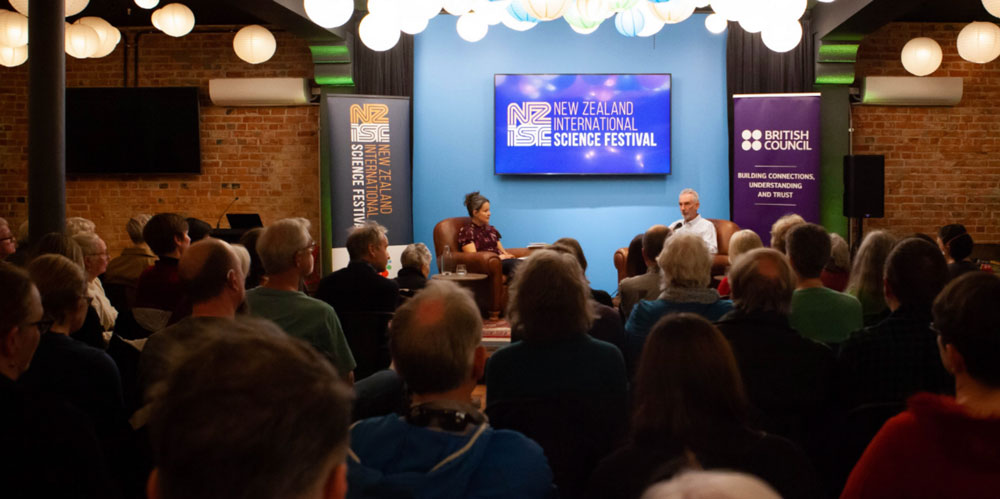
The New Zealand International Science Festival hosted Prof Jackson this year with the support of the British Council New Zealand and the Pacific. He is joined by the Director of the Centre For Sustainability, Caroline Orchinson, for this evening talk.
While we need less growth to put less demand on the planet's resources and slow down climate change, CUSP director Tim Jackson argues that we need more art, more plays and works of fiction to bring both sides of that argument to life.
To provide prosperity for all while respecting planetary boundaries, it is imperative we transcend both the conventional growth-centred worldview and our growth-dependent economic and social systems. Tim Jackson explores how to get there.
Growth is unsustainable. But the world beyond growth is frightening. We have built an economy that is dependent on growth. We must learn anew how society works, when the economy is not growing. And we need to confront the impossibility theorems presented to us by those who resist change.
Care is an anathema to capitalism. Its virtues are capitalism’s vices. Its employment-rich foundation for wellbeing is capitalism’s ‘productivity crisis’. Yet, without care we are nothing, our progress is nothing. Without care there is no economy.
On 15-17 May 2023, scientists, politicians, policymakers and civil society organisations are gathering in Brussels for the second Post-Growth Conference for Europe. The event is a cross-party initiative of 20 Members of the European Parliament, supported by a wide-range of partner organisations.
Tim Jackson was invited onto the Radio NZ Saturday Morning programme with Kim Hill to discus post-growth economics, staggering inequalities legitimated by the trickle-down ideology, and the motivation for his most recent book Post Growth-life after capitalism.
What may switching to a green economy mean for the way we live and work and is it compatible with economic growth? Together with his invited guests and co-hosts, Amol Rajan is exploring key questions around money, prosperity and the green economy.
In the Cop27 special, Ian Sample speaks to Tim Jackson about the myth of eternal growth, other ways to think about progress and prosperity, and what an economic system in balance with our planetary system might look like.
As the twin storms of economic turmoil and worsening climate change grip the the world, BBC Radio 4 Analysis examines the future of economic growth. Does it offer a route out of economic malaise, or have its benefits reached a ceiling for developed countries?
In an exciting new partnership with Corner Shop Media Productions, Parents for Future UK and Zero Carbon Guildford, CUSP is co-sponsoring a new weekly podcast series hosted by seasoned journalists Babita Sharma and Katy Glassborow. Mum, Will the Planet Die Before I Do? explores our role as parents and carers in tackling the climate crisis.
Roundtable event with Dennis Meadows, Robert Costanza, Kate Raworth, and Tim Jackson; contributing to the theme of post-growth thinking within the EU institutions and across EU Member States.
On 9 February 2022, CUSP director Tim Jackson gave oral evidence to the Environmental Audit Committee on their beyond GPD inquiry, addressing questions around growth dependency and the limitations of the 'inclusive wealth' concept.
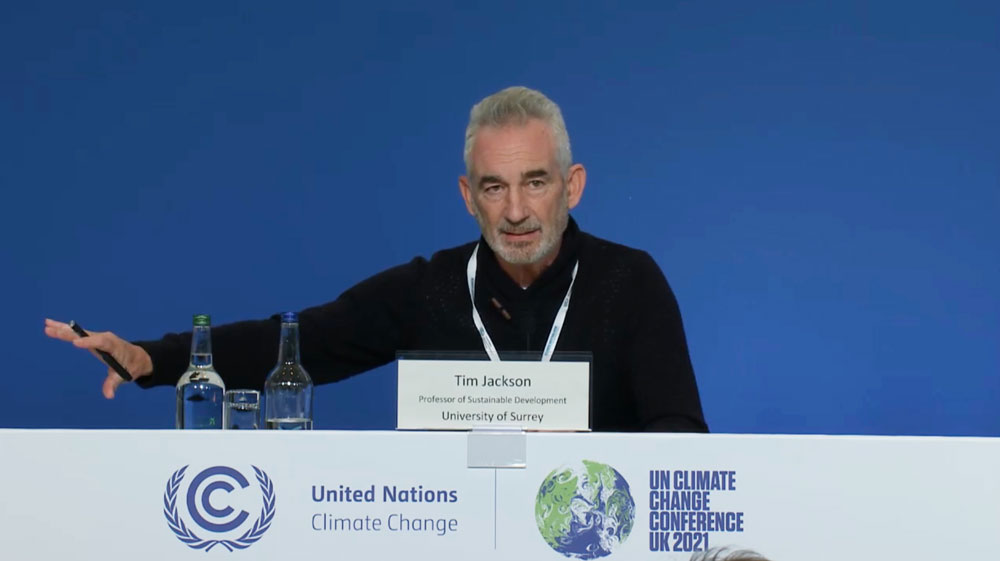
Press conference on post-growth economics, zero carbon sooner and the climate economics challenge at #COP26. Hosted by Scientists Warning Europe, 5 November 2021.
Listen in for a sobering, gripping, and stubbornly optimistic conversation about the most decisive decade in human history. How can we change the stories we tell ourselves, to engage, inspire and empower people toward climate action?
Impact investing is a driving force in the transition to a more inclusive and sustainable world. In this podcast series, Tim Jackson and Hans Stegeman discuss the shortcomings of our current economic system and explore how the financial sector can play a crucial role in providing the capital needed to realise real and profound change.
INET's Executive Director Rob Johnson talks with Jackson about his new book, "Post Growth: Life after Capitalism," and how we might break free of the cycle of restrictive thinking which has plagued economics, and the world.
Is relentless economic growth the best way to measure human progress? Tim Jackson in conversation with Matthew Taylor as part of the RSA 'Bridges to the Future' podcast series, putting "practitioners on the spot by asking for one big idea to help build effective bridges to our new future."
Can an economy grow and curb climate emissions? That’s the dual feat that President Joe Biden is trying to accomplish. Economists and environmentalists are split on this question. The World’s host Marco Werman discusses this with climate scientist Zeke Hausfather at The Breakthrough Institute in California, and ecological economist Tim Jackson at the University of Surrey whose book, “Post Growth: Life After Capitalism,” comes out end of May.
In this podcast, hosts Zoe Williams and Luke Cooper talk to Tim Jackson, about his new book, Post-Growth; Life After Capitalism. Every society in the world shares a fundamental cultural assumption about how our economies work: that growth is good. But what if this is running up against both its material and ecological limits?
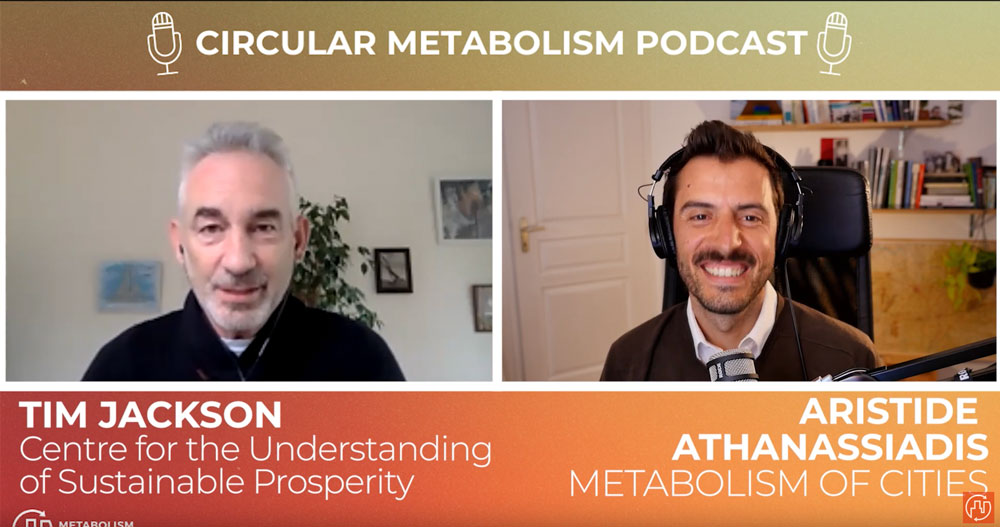
The Circular Metabolism podcast is hosted by Aristide Athanassiadis from Metabolism of Cities. In his podcast he interviews thinkers, researchers, policy makers and practitioners to better understand the metabolism of our cities and how to reduce their environmental impact in a socially just and context-specific way.
In this podcast Will Brehm and Tim Jackson talk about the power of ideas and imagine what life might look like after capitalism. In his new book, Post Growth: Life after capitalism, Tim shows the limits of the dominant metaphors used to explain our current world and argues for new metaphors to help imagine a sustainable, just, and creative future.
Conversation with Mathew D. Rose as part of the event series “Ökonomie jenseits der Schwäbischen Hausfrau”, hosted by Brave New Europe, Helle Panke eV and the Rosa Luxemburg Stfitung. More details via the Brave New Europe website.
In this short video from Al Jazeera, CUSP Director Tim Jackson breaks down some of the lessons learned from the pandemic, as pressure builds to fix devastating economic inequality.
The possibility that we can live better, healthier and more fulfilling lives without the relentless consumption that damages the planet was one of the points of discussion when BBC presenter Nihal Arthanayake invited CUSP Director Tim Jackson and Policy Exchange analyst Benedict McAleenan to discuss the implications of Sir David’s remarks on Radio 5 Live’s Afternoon Edition today. Good lives don’t have to cost the earth. It’s time for capitalism to recognise that.
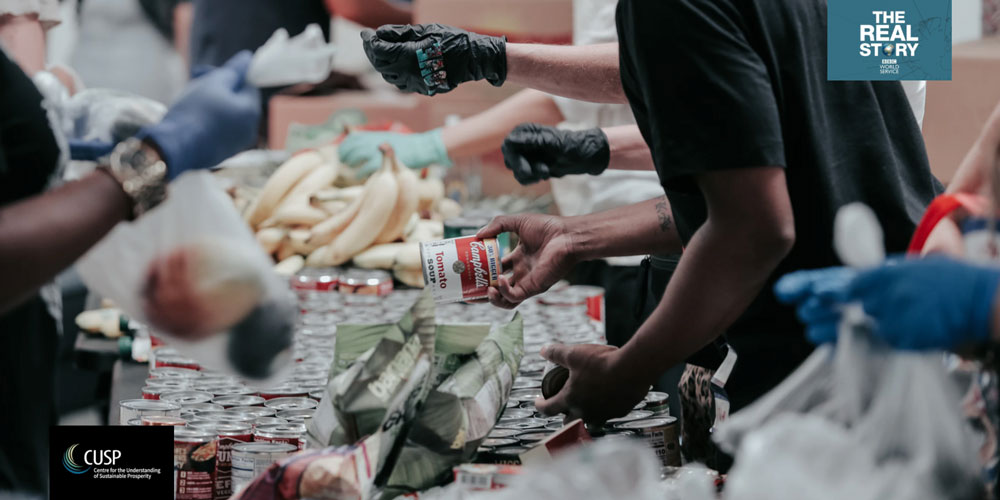
Millions have been left without work as the coronavirus pandemic continues to devastate economies across the globe. How does surging unemployment complicate the global response to the pandemic? Dan Damon and a panel of experts discuss what should be done for the BBC World Service.
Panel discussion with CUSP Director Tim Jackson, Maria Joao Rodrigues (Foundation for European Progressive Studies), Apollonia Miola (OECD) and Meera Ghani (ECOLISE); hosted by Peter Schmidt (EESC).